Page 1
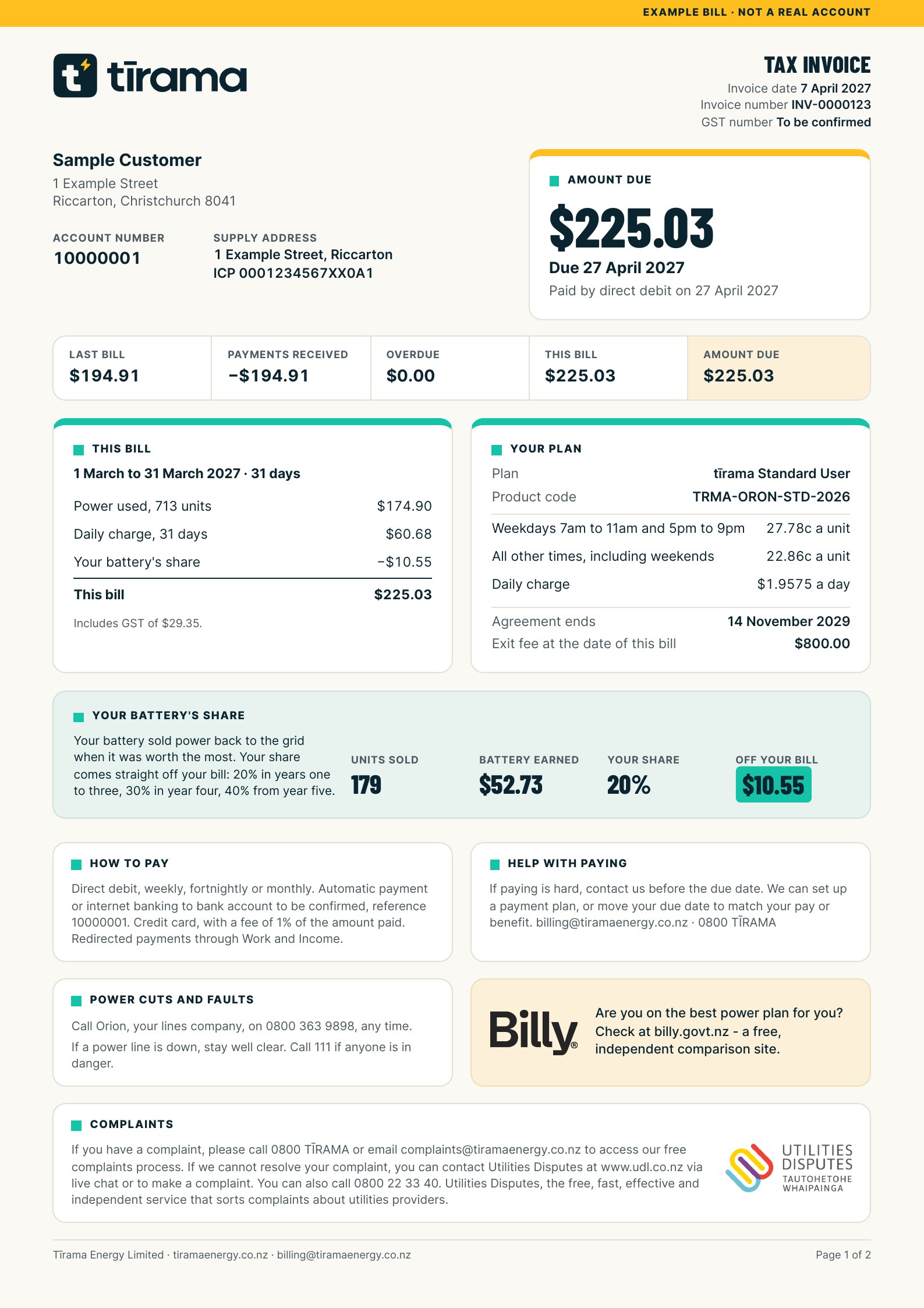
Account number
The number for your tīrama account. Use it as the reference when you pay by internet banking, and have it handy when you contact us.
Supply address and ICP
The address we supply power to, and its ICP number. ICP stands for installation control point. It's the unique number for your home's connection to the power network, and it stays with the address when people move.
Tax invoice details
The date we issued your bill, the invoice number and our GST number. Your bill is a tax invoice.
Amount due
What you need to pay, and the date it's due. Bills are due 20 days after we send them. If you pay by direct debit, this is the amount we'll take and the date we'll take it.
Your account balance
How the amount due adds up: your last bill, the payments we've received since, anything overdue, and this bill. An overdue amount shows here with the period it's for.
This bill
The total for the billing period, with the dates it covers and the number of days. It's the power you used plus the daily charge, less your battery's share. The total includes GST.
Your plan
The name of your plan and its product code. The product code identifies your exact plan, so you can compare it on Billy or against our other plans.
Your rates
Your prices, including GST. Power used on weekdays from 7am to 11am and from 5pm to 9pm is charged at one rate. Power used at all other times, including weekends, is charged at a lower rate. The daily charge applies every day, however much power you use. Your power rate
Agreement end date and exit fee
The date your three-year agreement ends, and what it would cost to leave on the date of your bill. The fee is $25 for each month left to run, so it drops by $25 every month and is nil after 36 months.
There's no exit fee for a verified house move, or if we put up your rate or daily charge. The agreement
Your battery's share
Your battery sells power back to the grid when it's worth the most. This shows how many units it sold, what it earned, and your share, which comes straight off your bill.
Your share is 20% in years one to three, 30% in year four and 40% from year five. The dollar amount changes from month to month because it follows what the battery actually earns: most in autumn and winter, least in late spring and summer. Your share
How to pay
Direct debit (weekly, fortnightly or monthly), automatic payment, internet banking, credit card, or redirected payments through Work and Income. Paying by credit card carries a fee of 1% of the amount paid; every other way costs the same.
Help with paying
If paying is hard, contact us as early as you can, before the due date. We can set up a payment plan, smooth your bill across the year, or move your due date to line up with your pay or benefit. With your permission, we can also put you in touch with free budgeting support. Hardship
Power cuts and faults
Your lines company owns the poles and wires that bring power to your street. For a power cut or a fault, call them. For your bill, your account or your battery, contact us. Power outages
Comparing plans
Billy is the Electricity Authority's independent comparison site. Use it to check whether another plan, with us or another power company, would suit you better. billy.govt.nz
Complaints
Contact us first with any complaint. If we can't resolve it, you can take it to Utilities Disputes, the independent service that sorts complaints about utility providers. It costs you nothing. Complaints
Page 2
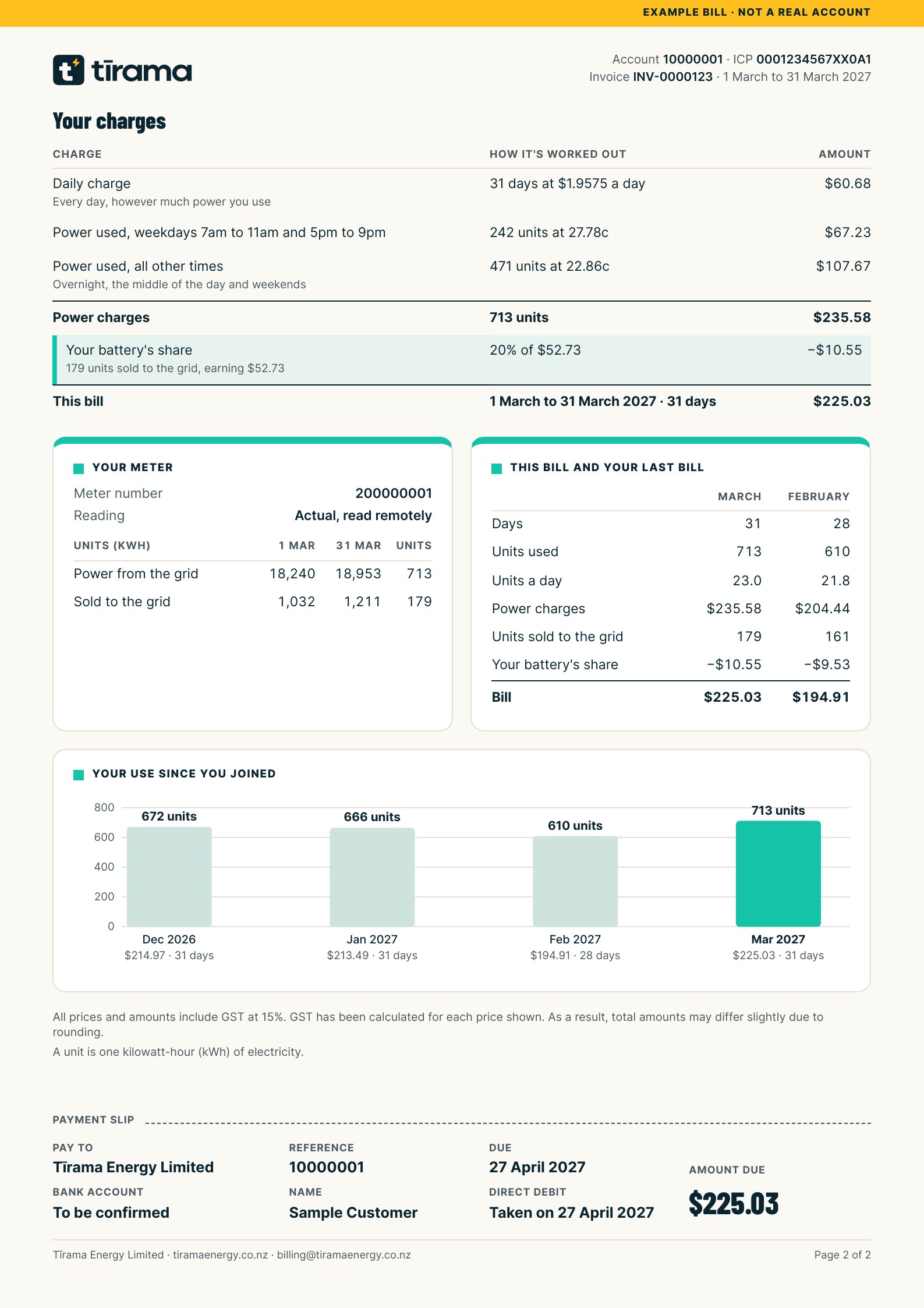
Your charges
Each charge, how it's worked out and what it comes to. Units multiplied by the rate gives each power charge. Days multiplied by the daily rate gives the daily charge. Your battery's share comes off the total.
Your meter
Your smart meter records the power your home takes from the grid, and the power your battery sells back, every half hour. Our metering provider reads it remotely, and Actual means your bill uses real readings.
If a reading is missing, we estimate it. Your bill then says "based on an estimated reading", and we correct it once the real reading comes in. You can also send us your own reading at billing@tiramaenergy.co.nz.
This bill and your last bill
This month next to last month: the number of days, the units you used, units a day, what you paid for power, what your battery sold and your share.
Your use since you joined
The units you've used each month since you joined, with what each bill came to. After your first year it shows the last 13 months, so you can compare a month with the same month a year earlier.
GST and units
All prices and amounts on your bill include GST at 15%. GST is worked out on each price, so totals can differ by a cent or so from rounding. A unit is one kilowatt-hour (kWh), the standard measure of electricity.
Payment slip
Our bank details and the reference to use when you pay by internet banking. If you pay by direct debit, it shows the amount and the date we'll take it.
Paying and changes
When your bill arrives
We bill monthly, for the month just gone. Your bill is emailed within five business days of the end of the month, and it's due 20 days after we send it.
Your first tīrama bill arrives within a month of your battery being switched on. Your previous power company sends a final bill for power used up to the day you switched.
Changing your due date
If a different due date suits your pay or benefit, contact us at billing@tiramaenergy.co.nz and we'll set it up. There's no fee.
Why one bill differs from the next
Three things move your bill from month to month: the number of days in the billing period, how much power you use (most homes use more in winter), and what your battery sold, which is highest in autumn and winter and lowest in late spring and summer.
Changes to your rates
We give you at least 30 days' notice before a change to your rates takes effect. If an increase is more than 5%, we write to you directly.
If we put up your rate or daily charge, you can leave with no exit fee.
Your final bill
When your agreement ends, your final bill is issued within five business days of your account closing and your battery being collected.
If you think your bill is wrong
Contact us at billing@tiramaenergy.co.nz. You can ask for the meter data we hold for your home at any time, at no charge. If you think a reading is wrong, tell us. We'll have it checked, and correct your bill if it was.